The Summer Without a Summer: How Mary Shelley Dreamed Up Frankenstein in 1816
Published November 3, 2026 · Moth & Quill Press
Some novels are planned. Frankenstein was dared into existence.
A year without a summer
In April 1815, Mount Tambora erupted in what is now Indonesia. The ash it threw into the atmosphere dimmed the sun across the Northern Hemisphere, and 1816 became known as "the year without a summer": failed harvests, cold rain in June, and thunderstorms that rolled down the Alps for weeks.
That summer, a small group of English writers found themselves shut indoors on the shore of Lake Geneva. Lord Byron had rented the Villa Diodati. Nearby stayed Percy Bysshe Shelley and Mary Wollstonecraft Godwin — not yet Mary Shelley — along with her stepsister Claire Clairmont and Byron's physician, John Polidori.
The ghost-story challenge
Trapped by the weather, they read German ghost stories aloud. Then Byron proposed a contest: each of them would write a ghost story of their own.
Most of the attempts went nowhere. Byron abandoned his. Percy Shelley lost interest. Polidori's effort eventually became The Vampyre, one of the first vampire stories in English. And Mary, by her own later account, tried for days and could think of nothing at all.
She was eighteen.
The waking dream
In the introduction she wrote for the 1831 edition, Mary Shelley described what finally broke the silence. After a long evening of conversation about the principle of life — galvanism, experiments, whether a corpse might be reanimated — she went to bed and could not sleep. Instead, with her eyes closed, she saw it: a "pale student of unhallowed arts" kneeling beside the thing he had put together, and the thing beginning to stir.
The next morning she announced that she had her story. What she had imagined as a short tale grew, with Percy's encouragement, into a novel. Frankenstein; or, The Modern Prometheus was published anonymously in January 1818. She was twenty.
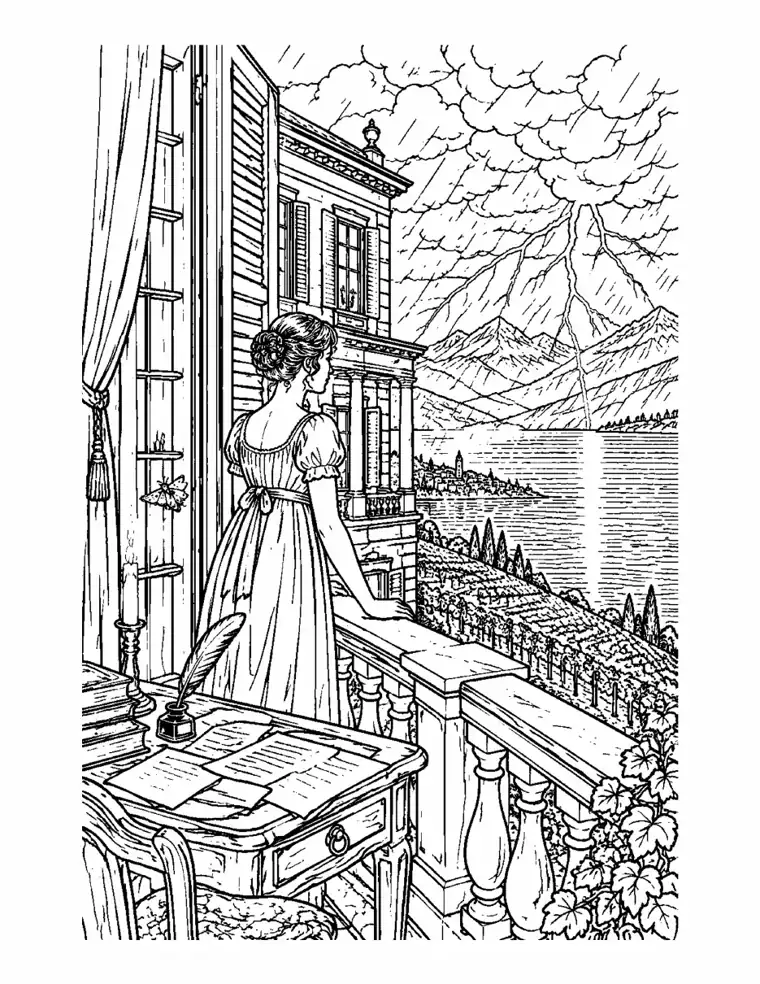
Why our coloring book opens at Villa Diodati
When we planned Frankenstein: A Gothic Coloring Journey Through Mary Shelley's Classic, it seemed wrong to begin with Victor. The novel itself opens with a frame — Captain Walton's letters from the Arctic — and the story of its writing is a frame around that frame.
So the book starts with a bonus prologue: Mary at the window above the lake, lightning over the mountains, a candle and a quill on the desk behind her. It is the scene before Scene 1. The facing page tells the 1816 story in brief, so that by the time you reach Walton's ship you know whose imagination you are traveling through.
And yes — the moth is already hidden in the prologue. It is in every one of the 50 scenes that follow, too.
Curious which scenes made it into the book?
From one sleepless night to 50 scenes
The prologue sets the tone for the whole Mary Shelley coloring book. Every illustration after it follows the novel in story order, from the Arctic letters through Victor's childhood, the laboratory, the creature's long education beside the De Lacey cottage, the glacier, the Orkneys, and the final chase across the ice. Each has a short summary and a quotation from the text on the facing page.
If you are new to the book, our scene-by-scene overview of the Frankenstein coloring book explains how the 50 scenes are arranged. If you are curious how Shelley actually described her creature — rather than how the films did — read the creature vs the Hollywood monster.
Coloring the prologue: a few suggestions
- The sky does the storytelling. The 1816 summer was famous for its storms; heavy slate and violet tones make the lightning feel earned.
- Keep one warm light. A single candle on the desk is the only warmth in the room. Leaving it as the brightest point on the page echoes the moth-and-flame idea behind the press.
- Lake Geneva at night takes deep blue-greens well, with the town lights as tiny ochre points.
These are only suggestions. The page is yours.
Frequently asked questions
Where was Frankenstein written?
Mary Shelley conceived the story in June 1816 at Lake Geneva, Switzerland, during the gathering at Lord Byron's rented Villa Diodati. She continued writing it after returning to England, and it was published in January 1818.
How old was Mary Shelley when she wrote Frankenstein?
She was eighteen when she began the story in the summer of 1816 and twenty when the novel was published in 1818.
What was the "year without a summer"?
1816, when ash from the 1815 eruption of Mount Tambora disrupted weather across the Northern Hemisphere, bringing cold, rain and storms to Europe — the weather that kept the Diodati group indoors.
Does the coloring book include the Villa Diodati story?
Yes. Frankenstein: A Gothic Coloring Journey Through Mary Shelley's Classic opens with a bonus prologue illustration and summary about the 1816 origin of the novel, before the 50 story scenes.
Frankenstein: A Gothic Coloring Journey Through Mary Shelley's Classic — 50 scenes, facing summaries and quotes, a hidden moth in every page. Paperback, $13.32.
See the book and buy it on Amazon
Available on Amazon from the book page. A coloring and reading book for entertainment and enjoyment — not a therapeutic or wellness product.